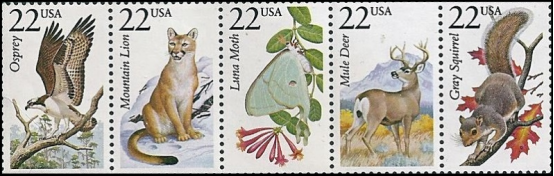
The 1987 North American Wildlife issue is memorable before you identify a single animal: it is a pane of 50 different 22-cent stamps, all designed and painted by wildlife artist Chuck Ripper.
Issue date and setting
USPS issued the pane on June 13, 1987, at CAPEX ’87, the international philatelic exhibition in Toronto. The animals represent the geographic range and biodiversity of North America, including Alaska and Hawaii.
Why 50 designs?
The project initially considered state animals, but several states did not have an official state animal. The finished issue used the large format to present a broader wildlife survey without printing state names on each stamp.
Chuck Ripper’s approach
Ripper was an experienced wildlife illustrator. Smithsonian research notes the anatomical and environmental accuracy of the paintings: each animal is presented with habitat details rather than as a floating emblem.
Collecting the issue
- A complete pane preserves the intended 50-design composition.
- Individual used stamps can form a species or habitat collection.
- A CAPEX-related cover or first-day cancellation adds event context.
- Condition matters because a large pane is vulnerable to folds, separated perforations, and backing damage.
What not to claim
The issue can support education and appreciation, but evidence is needed before claiming that it measurably changed public knowledge or conservation behavior. Historical context and demonstrated impact are different questions.
The Smithsonian provides both a detailed issue study and individual object records.
Build a verifiable record of the 50-design pane
The 1987 North American Wildlife issue rewards close study because a complete pane presents many species together. When cataloging it, record whether you have a full pane, a block, a single, or a used example. A species list copied from a seller is not enough: match each label to the pictured position and compare it with a catalog or museum record.
What condition notes should include
- Missing selvage, separated perforations, bends, or gum disturbance on a pane.
- Cancellation placement and legibility on used singles.
- Fading or color shift, especially when an item was displayed in sunlight.
- Whether packaging is original or later dealer material.
The educational value often comes from the relationships across the pane—habitats, geographic range, and species selection—rather than from treating each single as rare. If you create a display, label interpretations separately from issue facts and cite the wildlife source used for current species names.
Compare issue data with the National Postal Museum collections and USPS archival material. Our beginner guide explains safe handling, while the history hub connects other design studies.
Related collecting guides
Editorial note: Historical claims in this article are based on cited USPS and Smithsonian material. MaxPob’s local keyword and review datasets help identify reader questions and collecting concerns; marketplace reviews are not used as proof of postal history, rarity, or value. See our research methodology.
Primary topic: U.S. Stamp History. Start with The First U.S. Postage Stamps.