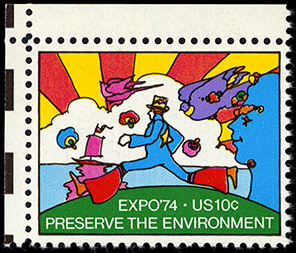
U.S. stamps from the 1970s are useful historical objects because the decade changed both the postal institution and the visual language appearing on everyday mail.
A new USPS and changing rates
The Postal Reorganization Act transformed the Post Office Department into the United States Postal Service in 1971. Collectors can follow that institutional change through inscriptions, rates, definitive series, and postal stationery—not only commemorative subjects.
Definitives in transition
The Prominent Americans series remained in use into the late 1970s while the Americana series began replacing it. Formats and denominations make these regular issues rewarding to study even when individual examples are common.
The 1973 Love stamp
Robert Indiana’s LOVE design was adapted for an eight-cent stamp issued January 26, 1973. The bold stacked letters and tilted O brought a recognizable piece of contemporary graphic art onto ordinary mail. USPS did not yet treat “Love” as the continuing series name; later issues established that tradition.
Bicentennial mail
As the United States approached 1976, stamps and postal material became part of a much larger public commemoration. A useful collection can compare official historical imagery with the envelopes, cancellations, local events, and correspondence in which people actually used it.
How to build a 1970s study
- Choose one year or definitive series.
- Include correctly rated covers where possible.
- Record issue and cancellation dates.
- Compare design with the social and institutional context.
- Avoid unsupported claims based only on visual style.
Use the Smithsonian pages on definitive issues and the 1973 Love issue as starting sources.
Test a decade narrative against individual issues
It is tempting to say that every 1970s stamp reflects the decade in the same way. A stronger approach is to sample issues across several categories—public events, people, nature, art, and routine definitive postage—and record what USPS said about each issue. Patterns should emerge from the sample rather than be imposed before research begins.
A simple comparison table
- Issue name, date, denomination, and postal function.
- Designer, artist, or source image when credited.
- National event or anniversary named in the announcement.
- Printing or format detail relevant to identification.
- One external historical source that confirms the wider context.
Remember that a stamp shows an institutional choice about commemoration; it is not a neutral census of everything Americans valued. Note omissions and competing interpretations. For collecting, also distinguish an ordinary used single from an intact pane, plate block, first-day cover, or documented variety before discussing availability.
Use the National Postal Museum and USPS historical material for primary context. Our history hub organizes related decade and design studies.
Related collecting guides
Editorial note: Historical claims in this article are based on cited USPS and Smithsonian material. MaxPob’s local keyword and review datasets help identify reader questions and collecting concerns; marketplace reviews are not used as proof of postal history, rarity, or value. See our research methodology.
Primary topic: U.S. Stamp History. Start with The First U.S. Postage Stamps.