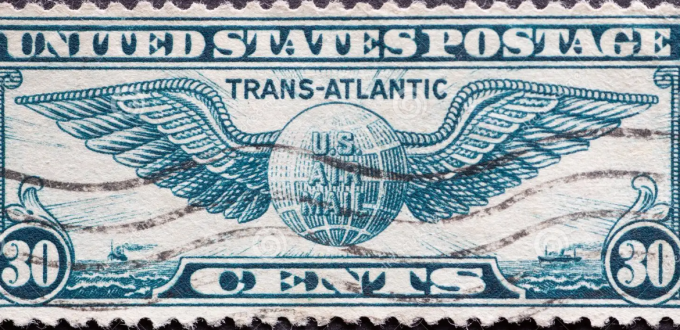
The first general-issue U.S. postage stamps went on sale in New York City on July 1, 1847. The five-cent stamp pictured Benjamin Franklin; the ten-cent stamp pictured George Washington.
Mail before federal postage stamps
Before 1847, a postmaster could write the amount due or mark a prepaid letter. Price depended partly on distance and the number of sheets. Some local carriers and postmasters used adhesive stamps before the federal general issues, but those are distinct from the 1847 national stamps.
Why Franklin and Washington?
Franklin had served as the first American Postmaster General under the Continental Congress in 1775, while Washington represented the new nation’s founding leadership. Their portraits linked the new prepayment system with recognizable public figures.
A short timeline
| Year | Milestone |
|---|---|
| 1775 | Continental Congress appoints Benjamin Franklin Postmaster General |
| 1847 | First U.S. general-issue postage stamps go on sale |
| 1855–1856 | Prepayment becomes mandatory and stamps become required for that prepayment |
| 1857 | Perforated U.S. stamps begin replacing stamps cut from sheets with scissors |
| 1893 | First U.S. commemorative series honors the World’s Columbian Exposition |
| 2007 | First Forever Stamp is issued |
How to study an 1847 stamp responsibly
Do not identify a valuable early issue from a portrait alone. Reprints, reproductions, altered examples, and later designs can look convincing in photographs. Use a specialist catalog and qualified expertization for a potentially important item.
USPS documents the sequence in its history of stamps and postcards. The Smithsonian provides object records for comparison and further research.
Keep three early-mail milestones distinct
A clear U.S. stamp timeline separates postal service before stamps, local or provisional issues, and the first federal general-issue postage stamps of 1847. Mixing those categories makes a simple origin story sound more certain than the historical record supports. Record who issued an item, where it was valid, and whether it represented federal postage.
How to evaluate an early-stamp claim
- Match the design and denomination to a museum or catalog record.
- Check whether the date refers to authorization, printing, sale, or first known use.
- For a cover, study the cancellation, route, rate, and correspondence together.
- Treat provenance and expert certification as essential for high-value material.
Early U.S. stamps are heavily reproduced in books, souvenirs, and online images. A visual resemblance does not authenticate an item, and MaxPob cannot authenticate one from a photograph. Do not remove a suspected early stamp from its cover; the postal context may carry much of the historical and financial value.
The National Postal Museum collections provide object-level context. Continue through our U.S. stamp-history hub, which separates timelines, design studies, and collector guidance.
Related collecting guides
Editorial note: Historical claims in this article are based on cited USPS and Smithsonian material. MaxPob’s local keyword and review datasets help identify reader questions and collecting concerns; marketplace reviews are not used as proof of postal history, rarity, or value. See our research methodology.
Primary topic: U.S. Stamp History. Start with The First U.S. Postage Stamps.